
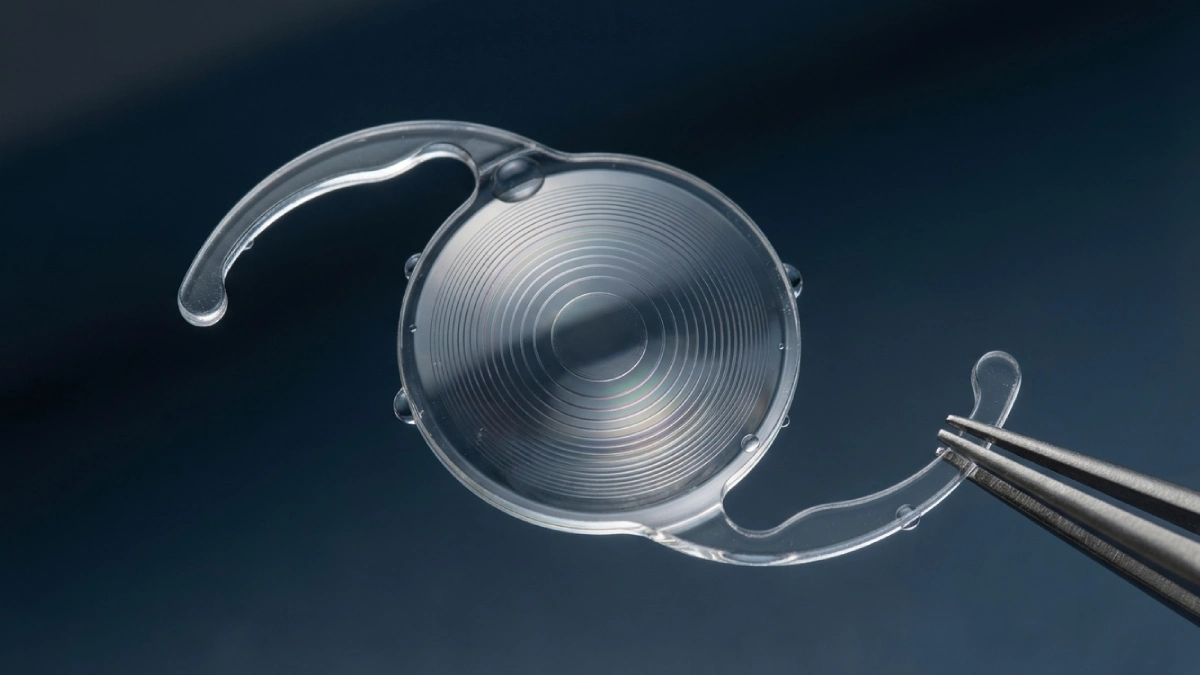
Presbyopia-correcting lens implants are artificial lenses placed inside the eye to reduce the need for glasses at different distances in suitable patients. The term “smart lens”, commonly used in Türkiye, does not identify one technical class of implant. It may refer to multifocal, trifocal or extended depth of focus (EDOF) designs. Suitability depends on cataract status, retinal and corneal health, the ocular surface and individual visual needs.
These lenses are not suitable for everyone and cannot guarantee freedom from glasses. Choosing an implant involves more than asking for additional focal points. Reading habits, night driving and willingness to use glasses are part of the decision alongside examination findings.
What Are Presbyopia-Correcting Lens Implants?
Presbyopia-correcting intraocular lenses aim to address the age-related loss of near focusing ability. An intraocular lens, or IOL, is an artificial lens implanted surgically inside the eye. “Smart” does not mean that an implant is electronic, uses artificial intelligence or treats every eye condition. The specific optical design matters more than a general marketing label.
During cataract surgery, the surgeon removes the cloudy natural lens and replaces it with an artificial one. In selected people without cataracts, lens replacement may also be considered to reduce dependence on glasses. However, the reason for surgery and the balance of benefits and risks differ between these situations.
An IOL should not be confused with a contact lens. Contact lenses sit on the eye surface and can be removed. The implants discussed here remain inside the eye. Phakic lenses, which are implanted while retaining the natural lens, form a separate surgical category and are not the same as routine lens replacement.
How Do These Lens Implants Work?
An IOL focuses light onto the retina, the light-sensitive tissue at the back of the eye. A monofocal lens primarily provides a focus for one chosen distance. Multifocal designs create more than one focus, while EDOF lenses aim to extend the range of clear vision. These optical approaches have different benefits and limitations.
Implantation does not necessarily restore the focusing flexibility of a young natural lens. Trifocal and EDOF designs support vision at different distances through their optical structure. Reading small print, using a computer and driving at night may therefore involve different levels of visual performance.
The brain's adjustment to the new image can also affect the experience. Nevertheless, blurred vision should not automatically be explained as “the brain will adapt”. Ocular surface disease, residual refractive error, astigmatism and retinal conditions may need separate investigation.
What Types of Lens Implants Are Available?
Multifocal and Trifocal Lenses
Multifocal IOLs provide more than one focus. Trifocal lenses belong to this group and aim to support distance, intermediate and near vision. Intermediate vision includes tasks such as viewing a computer screen. The working distances and optical characteristics are not identical across all models.
These designs can reduce the need for glasses for some everyday tasks. However, halos around lights, glare and reduced contrast sensitivity may occur. Contrast sensitivity means distinguishing between similar shades. This can be important for night driving even when letters on an eye chart are clear.
A Cochrane review comparing multifocal and monofocal implants examined reduced spectacle dependence alongside light-related symptoms. The diversity of implants and the age of the included studies limit direct application of its findings to every current model.
Extended Depth of Focus (EDOF) Lenses
EDOF stands for extended depth of focus. These lenses aim to provide a broader range of clear vision, particularly from distance to intermediate tasks. Glasses may still be needed for small print or prolonged close work. The label does not itself promise glasses-free vision at all distances or the absence of light-related symptoms.
The model matters when comparing EDOF and trifocal implants. A 2024 Cochrane review relied on limited, short-term studies comparing trifocal lenses with a specific EDOF design. Findings suggested better near vision with trifocals, but evidence certainty was low. Not detecting a clear difference in light-related symptoms does not prove equivalence.
Some enhanced monofocal lenses also aim to extend the visual range beyond that of standard designs. They should not automatically be classified as trifocal implants. Ask about the actual optical design and expected performance rather than relying on the product category's promotional name.
How Do Monofocal and Presbyopia-Correcting Lenses Differ?
The main difference concerns the distances targeted for unaided vision and the optical compromises involved. A monofocal implant is not necessarily a less appropriate or inferior choice. Priorities for visual quality and coexisting eye disease may make it the suitable option.
| Lens type | Main aim | Glasses and limitations |
|---|---|---|
| Monofocal | Clear focus at one chosen distance | Reading glasses are usually needed if distance is targeted; glasses may also be needed for other tasks. |
| Enhanced monofocal | Support intermediate vision alongside distance | Reading glasses may still be necessary; performance depends on design. |
| Multifocal / trifocal | Reduce spectacle dependence at several distances | Halos, glare and contrast problems may occur; glasses can still be needed. |
| EDOF | Extend the clear range for distance and intermediate vision | Reading glasses may be required; light-related symptoms remain possible. |
“Toric” describes an ability to correct suitable corneal astigmatism rather than a number of focal points. Monofocal, trifocal and EDOF lenses may have toric versions. Therefore, “toric or presbyopia-correcting?” does not always describe mutually exclusive options.
Who May Be Suitable for These Implants?
Presbyopia-correcting implants may be considered for cataract patients with suitable eyes who want less dependence on glasses at different distances. Age and prescription alone are insufficient. Retinal, optic nerve, corneal and ocular surface health, together with realistic expectations, all matter. Outcomes of surgical and interventional procedures can vary between individuals.
A cataract is clouding of the natural lens that can affect everyday vision. Deciding whether surgery is appropriate and choosing the implant type are related but separate decisions. First discuss why surgery is indicated, then which implant might suit you. See the overview of cataract treatment and surgical planning.
Defining visual goals makes the discussion more useful. How far away do you hold a phone? Where is your computer screen? How frequently do you drive at night? How acceptable would glasses be for fine print? These questions should come before choosing a brand.
Can Lens Replacement Be Performed Without Cataracts?
Yes, refractive lens exchange may be considered in selected patients. Its purpose is primarily to reduce dependence on glasses rather than to treat a cloudy lens. However, removing the natural lens is irreversible. Any remaining natural near focusing ability and the risks of intraocular surgery require particular consideration. [4]
Retinal detachment risk and the condition of the back of the eye are especially relevant in high myopia. Disliking reading glasses alone does not establish that surgery is suitable. Glasses, contact lenses and other approaches for suitable patients should also be discussed. Learn more about presbyopia and treatment options.
Who May Not Be Suitable?
Significant retinal or optic nerve disease, an irregular cornea and uncontrolled ocular surface problems may limit suitability for some presbyopia-correcting implants. A diagnosis alone does not create an identical prohibition for every patient. Severity, visual potential and the proposed optical design must be considered together.
Macular disease, diabetic retinal changes, glaucoma and corneal irregularities are relevant examples. If a condition already reduces contrast, additional optical effects may make daily vision harder. A monofocal approach may suit some people better, depending on the examination.
Dry eye can affect both measurement reliability and postoperative visual quality. The ophthalmologist may treat the ocular surface before repeating measurements. Previous laser eye surgery also calls for specialised calculations and corneal assessment; it does not automatically establish either suitability or exclusion.
Very high expectations for night vision, low tolerance of halos or a requirement never to wear glasses can make the decision more difficult. Discuss how acceptable these compromises would be before surgery. This helps establish realistic expectations.
Which Tests Guide Lens Selection?
The ophthalmologist assesses visual acuity, prescription, eye pressure and the front of the eye. Biometry measures the eye to calculate implant power. Corneal mapping, tear-film assessment and macular OCT when appropriate complete planning. OCT produces cross-sectional images of the central retina.
Share records of previous operations, prescriptions and all medicines. Before selecting a model, assessment should identify other problems that may limit vision. Even an advanced implant cannot necessarily overcome damage to the retina or cornea.
Benefits and Limitations
The main aim is to perform a wider range of daily activities without glasses in suitable patients. That benefit may involve accepting visual side effects. Advantages and disadvantages should be discussed in the context of the same person's lifestyle. A balance that suits one patient may not suit another.
- Potential benefit: Less dependence on glasses for distance, intermediate or near tasks, according to design.
- Optical limitation: Halos, glare or difficulty with contrast in dim light.
- Refractive limitation: Residual prescription or astigmatism may require glasses or further assessment.
- Disease limitation: The implant does not treat retinal, optic nerve or corneal disease.
Lens surgery also carries surgical risks, including infection, intraocular inflammation, eye pressure changes, macular swelling and retinal detachment. Some complications can cause permanent loss of vision. These should be distinguished from optical side effects.
Corneal laser surgery and lens replacement are different procedures. Laser reshapes the cornea; lens exchange removes the natural lens. Suitability depends on more than prescription strength. No single approach should be presented as universally superior.
How Is Lens Implant Surgery Performed?
During planned lens replacement, the surgeon removes the natural lens and implants an artificial lens of the calculated power. The operation may treat cataracts or serve a refractive lens exchange purpose. Calling an implant “smart” does not make surgery risk-free or give everyone the same outcome.
Local anaesthetic techniques are commonly used, although the plan depends on the patient. Through a small incision, the surgeon accesses and removes the natural lens and places the selected implant. Preparation, operating and assessment times vary; a single fixed duration would not apply to everyone.
If both eyes need treatment, timing depends on the eyes and surgical circumstances. Ask for written instructions about drops, existing medicines and returning to activities. Do not stop or change medicines yourself.
Vision and Adaptation After Surgery
Vision can fluctuate initially, and adjustment to the new optical system varies. Adaptation involves the brain becoming accustomed to the new image. It does not guarantee that all halos will disappear or that every cause of blurred vision will improve simply by waiting. Continuing symptoms need clinical review.
Follow-up may examine the ocular surface, residual prescription, implant position and other eye structures. Glasses may still be needed for fine print, dim lighting or prolonged work. Resume driving according to the ophthalmologist's assessment rather than simply because the eye feels comfortable.
The capsule behind the implant may become cloudy over time. Posterior capsule opacification is not a cataract growing back in the same natural lens. YAG laser treatment may be appropriate in selected cases. An examination should first identify the cause of reduced vision.
Do not wait for a routine appointment if you develop sudden vision loss, increasing pain, marked redness, new flashes or a curtain across your vision. Contact the surgical team, or attend an emergency eye service or emergency department if they are unavailable. Do not attribute these symptoms to adaptation.
Before deciding, ask for the implant's technical name, target distances, likelihood of needing glasses and alternatives. For the site's clinical and academic background, see Prof. Dr. Rıfat Rasier and the physician profile. Individual suitability requires a comprehensive eye examination.
Frequently Asked Questions
Will I still need glasses after a presbyopia-correcting implant?
Who may not be suitable for these implants?
Can I have lens replacement without cataracts?
Are EDOF or trifocal lenses better?
Can an implant correct astigmatism?
Does an intraocular lens last a lifetime?
Can cataracts return after lens replacement?
This content is for general information; diagnosis and treatment require a physician’s assessment.