
What Is Presbyopia (Age-Related Near Vision Loss)?
Presbyopia is the age-related loss of flexibility in the eye's natural lens, which makes it harder to focus up close. It commonly becomes noticeable around age 40–42 and may progress before eventually stabilising.
Think of the lens as a camera lens that can no longer adjust its focus as easily for nearby objects. People often find themselves holding reading material farther away to see it clearly.
What Causes Presbyopia?
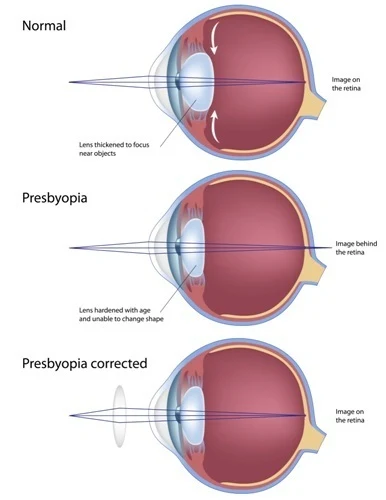
Normally, the eye's natural lens changes shape to focus on objects at different distances.
- When looking at something close, the ciliary muscles contract.
- The lens becomes thicker and more rounded.
- Light is brought into focus.
With age, however:
- The lens becomes stiffer.
- It loses some of its flexibility.
- Stiffening of the lens is the main cause.
As a result, focusing on nearby objects becomes more difficult. This natural age-related process is called presbyopia.
What Are the Symptoms of Presbyopia?
Presbyopia often develops gradually and becomes more noticeable over time.
Common symptoms include:
- Difficulty focusing on nearby objects
- Eye strain and fatigue
- Headaches after prolonged reading
- More difficulty seeing up close in the evening
Everyday signs may include:
- Holding reading material at arm's length
- Preferring a phone with larger buttons or text
- Increasing the font size on your computer
- Finding it harder to read in the evening than during the day
How Is Presbyopia Treated?
There is no single standard treatment for presbyopia. The approach is tailored to a person's age, eye anatomy, lifestyle and visual expectations.
Options fall into three main groups: glasses, contact lenses and surgical procedures.
Glasses and Contact Lenses
- Bifocal glasses
- Progressive (multifocal) glasses
- Multifocal contact lenses
These options improve near vision while they are being worn.
Presbyopia Surgery: Longer-Term Options
Surgical approaches can be divided into those that reshape the cornea and those that involve the lens inside the eye.
Corneal Laser Treatments
Monovision laser treatment
A conventional excimer laser procedure is used to adjust:
- One eye primarily for distance vision
- The other eye primarily for near vision
Not everyone adapts to monovision.
Some people may notice reduced depth perception.
Custom-Q PresbyLASIK
Custom-Q PresbyLASIK is an individualised laser approach used in presbyopia treatment.
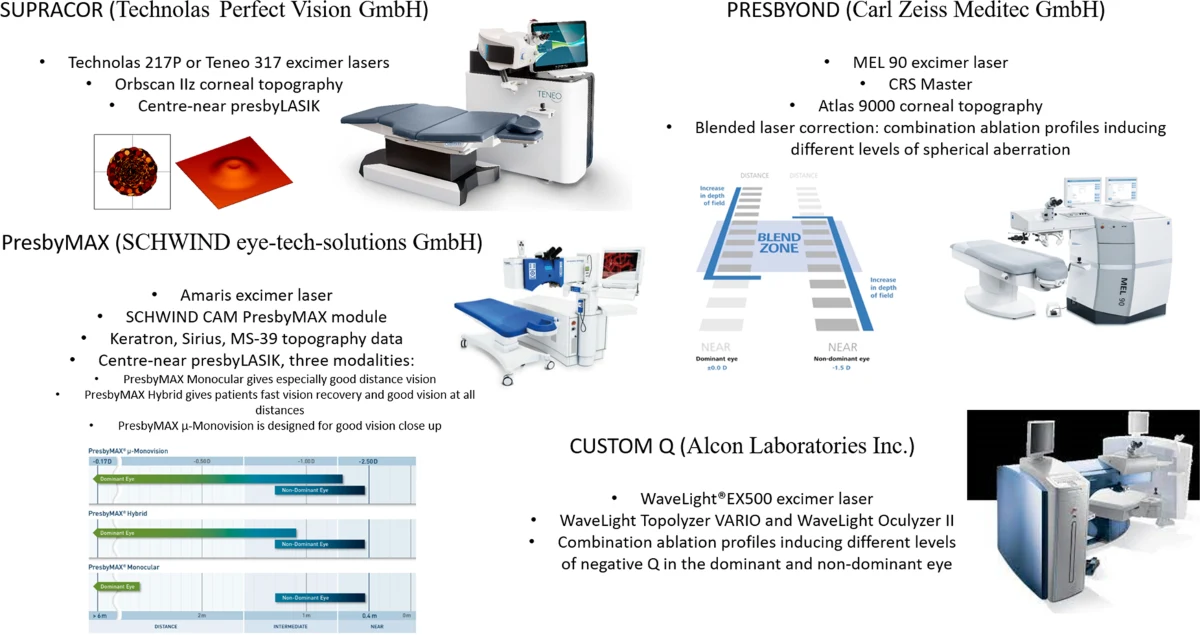
With this technique:
- The corneal surface is reshaped to suit the individual eye.
- Near, intermediate and distance vision are considered.
- The aim is to reduce some limitations of monovision.
Potential advantages include:
- Smoother transitions between viewing distances
- Greater comfort when using a computer or phone
- The possibility of an additional correction if needed
- Potentially easier adaptation
Custom-Q may be an option for active adults who spend time at a desk and wish to reduce their dependence on glasses. Suitability requires an eye examination.
Supracor laser treatment
Supracor uses a LASIK-based approach with an ablation profile designed to give different refractive properties to central and peripheral areas of the cornea, with the aim of supporting near, intermediate and distance vision.
Potential advantages include:
- No procedure inside the eye
- A lower risk of intraocular infection than intraocular surgery
- Further treatment options may remain available if needed
Lens-Based Surgical Options
Multifocal and Trifocal Intraocular Lenses
- The natural lens is removed.
- A lens designed to support near, intermediate and distance vision is implanted.
- This may be considered for people with cataracts or a relevant risk of cataract development, after a full assessment.
Add-On (Secondary Intraocular Lens) Technique
With an add-on lens:
- The natural lens or an existing artificial lens remains in place.
- A second multifocal or near-vision-supporting lens is implanted.
- The aim is to improve near vision.
This option may be considered particularly for people who:
- Have previously undergone cataract surgery
- Have a monofocal lens implant
- Wish to reduce their reliance on reading glasses
Allotex: A Human Corneal Tissue Approach
Allotex is a tissue-based corneal inlay approach for presbyopia. It uses prepared donor human corneal tissue placed within the cornea.
With this approach:
- The eye's natural lens is left in place.
- No lens is implanted inside the eye.
- Prepared donor corneal tissue is placed between corneal layers.
The aim is to change the cornea's optical properties to improve near and intermediate vision.
How Does Allotex Work?
The Allotex approach is intended to:
- Modify the optical properties of the central cornea.
- Increase the ability to focus at near distances.
- Preserve distance vision as far as possible.
Because the implant is made from human donor corneal tissue:
- It does not contain synthetic implant material.
- It is designed for tissue compatibility.
- The tissue is biologically derived.
- As with any implant, individual risks must still be assessed.
Potential advantages of Allotex
- Use of human donor corneal tissue
- No intraocular procedure
- Preservation of the natural lens
- No lens removal as part of the procedure
- Potential for removal or revision, subject to clinical assessment
- An additional tissue-based option for presbyopia
Who may be suitable?
Allotex may be considered for selected people who:
- Are approximately 40–55 years old
- Do not have a cataract
- Wish to reduce their dependence on reading glasses
- Have limitations that make corneal laser treatment less suitable
- Prefer to avoid lens surgery
Who may not be suitable?
- People with severe dry eye
- People with corneal disease, including keratoconus or corneal dystrophy
- People with an active eye infection
- People with serious retinal or optic nerve disease
Suitability can only be established after a detailed corneal and eye examination.
When Can I Return to Normal Activities?
After laser treatment:
- The laser part of the procedure may take approximately 2–3 minutes per eye.
- An overnight hospital stay is usually not required.
- Patients generally go home the same day.
- Stinging, watering and blurred vision may occur during the first 5–6 hours.
- Some people can resume routine activities the following day; recovery varies.
When assessing suitability, the structure of the eye matters more than the prescription alone. Corneal thickness must be within safe limits.
Are These Treatments Safe?
Laser and lens-based approaches to presbyopia may be suitable when patients are carefully selected. Every procedure has potential risks and benefits, which should be discussed individually.
Depending on the procedure, conditions that may rule out treatment or require particular caution include:
- Keratoconus
- Cataract
- Glaucoma
- Serious retinal or optic nerve disease
- Active eye infection
- Rheumatic disease or severe dry eye
- Pregnancy or breastfeeding
No medical procedure is completely risk-free. The type and likelihood of complications depend on the technique and the individual eye.
Can vision change again after surgery?
Corneal changes produced by laser treatment are generally long-lasting, but vision can still change with age. Small refractive changes may occur, and some people may need glasses or further treatment later.
There is no single best treatment for presbyopia. The most appropriate option depends on your eye anatomy and lifestyle. A decision should follow a detailed examination and a discussion of the available options with your ophthalmologist.
Frequently Asked Questions
What is presbyopia?
What are the symptoms of presbyopia?
How is presbyopia treated?
Who may not be suitable for surgery?
When can I return to normal activities after laser treatment?
Ask About Presbyopia Treatment
Some presbyopia procedures are brief, but recovery time and results differ from person to person. An eye examination can help determine whether glasses, contact lenses or a procedure best suits your needs.
Call for an appointment: +90 533 280 53 02