
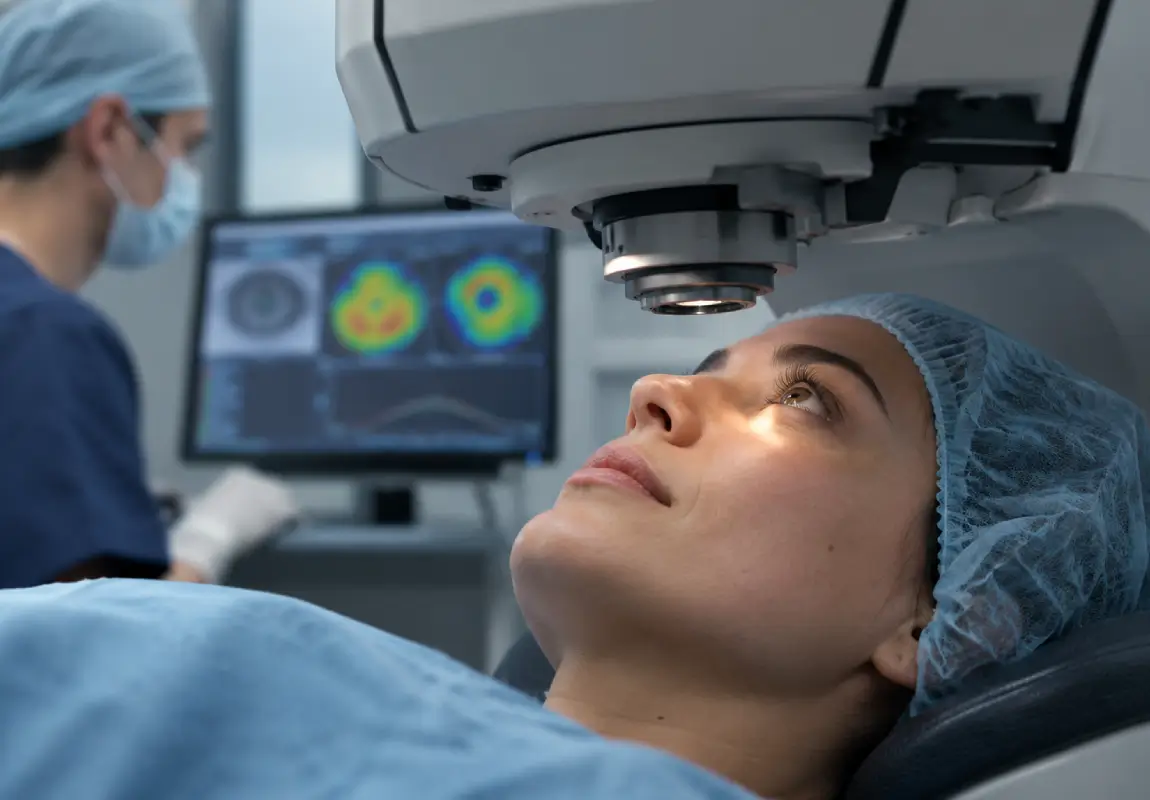
Laser eye surgery risks include dry eyes, halos around lights, difficulty seeing at night and a residual prescription. Symptoms may improve as the eyes heal, but some people develop lasting problems. Infection, corneal ectasia and permanent loss of vision are less common serious complications. An individual assessment is essential before deciding on surgery.
Laser vision correction aims to reduce dependence on glasses or contact lenses. Your prescription alone does not determine suitability. Corneal structure, the eye surface, lifestyle and expectations also matter. No procedure is suitable for everyone.
How Are Laser Eye Surgery Risks Assessed?
Laser eye surgery is not risk-free. Your ophthalmologist weighs the expected benefit against your eye characteristics and potential complications. Screening can identify risk factors, but it cannot guarantee an uncomplicated outcome. The discussion should include the option of not having surgery. [1] [2]
It helps to distinguish early postoperative symptoms from serious complications. Dryness, a gritty sensation and fluctuating vision can occur during healing. However, a symptom being common does not mean it is always mild or temporary.
Good results on an eye chart do not guarantee comfortable vision in every situation. Headlight glare or difficulty distinguishing detail in dim light may still affect daily life. Explain any need to drive at night during your consultation.
Possible Side Effects of Laser Eye Surgery
Dry Eyes
Burning, stinging, a gritty feeling and variable blurred vision can develop after surgery. Changes in corneal nerves and the tear film can contribute to these symptoms. Pre-existing dry eye may worsen, and some patients need ongoing treatment for the eye surface. [2] [3] [6]
Before surgery, your ophthalmologist examines the tear film, eyelids and ocular surface. Significant problems may require treatment first or postponement of surgery. The severity of dry eye and response to treatment influence the choice of procedure. Mild previous symptoms and uncontrolled ocular surface disease do not necessarily lead to the same recommendation.
Persistent pain or dryness that interferes with everyday life needs assessment. Marked pain that examination findings do not adequately explain also warrants further evaluation. Contact your surgical team rather than adding eye drops yourself.
Read more about dry eye disease and ocular surface assessment.
Light Sensitivity and Night Vision Problems
Some people notice halos, glare or starbursts around lights. Headlights may make these problems particularly noticeable at night. Contrast sensitivity—the ability to distinguish between similar shades—can also decrease. [2] [4]
These symptoms may ease during healing, but they do not always disappear completely. Visual quality problems can persist even with little or no remaining prescription. If your occupation involves night driving, discuss expected outcomes in relation to those tasks.
Under- or Overcorrection
Surgery may leave some refractive error or produce more correction than intended. Glasses or contact lenses may still be necessary. A later shift back towards the previous prescription is called regression. Not every episode of blurred vision indicates regression; dry eye and other causes also need consideration. [1] [2]
Presbyopia, the age-related loss of near focusing ability, differs from the return of a distance prescription. Someone with good distance vision may still need reading glasses as they get older. An enhancement procedure is not an automatic solution: the surgeon must reassess corneal shape and the remaining tissue.
What Are the Serious Complications of Laser Eye Surgery?
Infection, Inflammation and Corneal Scarring
A corneal infection can threaten sight. The cornea is the clear front surface of the eye; infection or abnormal healing can leave a permanent scar. After LASIK, non-infectious inflammation may also develop beneath the flap. These conditions require different treatment. [1] [5]
Do not wait for a routine appointment if pain, redness or vision worsens. Prompt assessment helps identify the cause and start appropriate treatment. Avoid assuming that a new or worsening symptom is simply part of normal healing.
Corneal Ectasia
Corneal ectasia is weakening and progressive distortion of the cornea. It can cause irregular astigmatism and reduced vision. Keratoconus or a suspicious corneal map is particularly important during preoperative assessment. Corneal thickness alone cannot establish suitability. [1] [5]
Topography or tomography assesses corneal shape, while surgical planning considers how the procedure will affect the tissue. If ectasia develops, treatment may aim to stabilise the cornea and improve vision. The appropriate approach depends on progression and examination findings.
Permanent Loss of Vision
Permanent, serious loss of vision after laser eye surgery is rare, but the risk is not zero. Severe infection, ectasia or permanent corneal damage may reduce sight. Some complications also reduce the best vision achievable with glasses. [2] [5] [7]
Reduced vision, complete blindness and disturbing night vision symptoms describe different outcomes. Research studies measure different endpoints, so a single universal “blindness rate” would be misleading. Ask your ophthalmologist to explain the relevant risks of the proposed procedure and what they mean for you.
Do LASIK, PRK and SMILE Have Different Risks?
Yes. LASIK, PRK and SMILE change the cornea's focusing power in different ways. Their recovery patterns and procedure-specific complications therefore differ. No technique is the safest option for every patient. Selection should reflect corneal findings and visual requirements. [1]
| Procedure | Main feature | Issues to consider |
|---|---|---|
| LASIK | A flap is created in the cornea. | Flap complications, dry eye and inflammation in the interface. |
| PRK | Laser treatment is applied to the corneal surface. | Early discomfort, surface healing and corneal haze. |
| SMILE | A small piece of corneal tissue is removed through a small incision. | Complications of tissue removal and changes in visual quality. |
SMILE does not create a LASIK-style flap, but that does not make it risk-free. PRK also avoids LASIK flap complications, while involving a different surface-healing process. Dry eye, infection, residual refractive error and ectasia can occur after different procedures. [1] [5]
Risk percentages from separate studies should not be compared without context. Patient selection, devices, complication definitions and follow-up periods can differ. For an overview, see the refractive laser treatment page.
Who May Not Be Suitable for Laser Eye Surgery?
Keratoconus, suspicious corneal findings, uncontrolled ocular surface disease or an unstable prescription may rule out surgery. Some findings represent a lasting contraindication; others require treatment and reassessment. A glasses prescription alone cannot answer the suitability question. [1] [3]
Your ophthalmologist will particularly consider:
- Keratoconus or corneal findings that suggest a risk of ectasia.
- Insufficient or otherwise unsuitable corneal tissue for the proposed procedure.
- Significant dry eye, active infection or ocular inflammation.
- A prescription that is still changing.
- Pregnancy and breastfeeding, when measurements may change.
- Medical conditions and medicines that may affect healing.
Diabetes or an immune-related condition does not lead to an identical recommendation for every patient. Disease control, eye findings and the proposed procedure all matter. Provide a complete medical history and details of all medicines. [1] [3]
Standard corneal laser vision correction is generally unsuitable in keratoconus. Specialised procedures used to manage the disease do not have the same purpose as routine refractive surgery. Learn more about keratoconus and corneal structure.
Which Tests Are Needed Before Surgery?
Assessment involves more than measuring your prescription. Your ophthalmologist checks how well glasses correct your vision, the shape of your cornea and the health of the eye surface. A dilated examination of the back of the eye may also be necessary. Testing depends on individual findings. [1]
- Refraction and visual acuity: Establish the prescription and vision with correction.
- Corneal topography or tomography: Assess corneal shape and suspicious irregularities.
- Corneal thickness: Helps calculate the effect of the planned procedure on corneal tissue.
- Tear film and eyelid examination: Checks for dry eye and ocular surface problems.
- Comprehensive eye examination: Includes eye pressure and other structures as appropriate.
If you wear contact lenses, ask the clinic how long to stop wearing them before assessment. The interval depends on lens type and corneal findings. Bring previous prescriptions and records of earlier eye surgery. These help assess prescription stability.
Which Symptoms Need Urgent Assessment After Surgery?
Sudden loss of vision, increasing pain or marked redness requires urgent assessment. Contact your surgical team without delay. If you cannot reach them, attend an emergency eye service or emergency department. Do not wait until your scheduled follow-up. [2] [5]
- Sudden reduction in vision or progressively worsening vision.
- Increasing pain, redness, discharge or pronounced light sensitivity.
- Pain or visual change after an injury to the eye.
- New flashes, a sudden increase in floaters or a curtain across your vision.
The last group can indicate a retinal problem and should not be treated as a normal effect of laser surgery. In particular, corneal laser treatment does not remove the retinal risks associated with high myopia. Use prescribed drops as directed and do not change medicines yourself when symptoms worsen. [5]
What Should You Ask Before Deciding?
Ask why a particular technique is recommended, as well as whether you are suitable. Discuss the risks most relevant to your eyes, night vision expectations and the possibility of continued glasses use. Clarify follow-up arrangements and whom to contact in an emergency.
Glasses and, for suitable patients, contact lenses are non-surgical options. Other surgical approaches have their own risks. Postponing treatment or choosing not to have surgery are valid decisions. Discuss your individual balance of benefits and risks with an ophthalmologist.
Describe your priorities using practical examples, such as night driving, prolonged computer work or wearing glasses during sport. This makes the expected benefit clearer. Ask which needs surgery may meet and which may remain unresolved. Read the written patient information and allow time to decide. Ask for clarification of any risk you do not understand rather than relying on a single success percentage.
References
- [1] ESCRS — Recommendations for Refractive Surgery
- [2] FDA — What are the risks and how can I find the right doctor for me?
- [3] FDA — When is LASIK not for me?
- [4] FDA — LASIK Quality of Life Collaboration Project
- [5] AAO EyeWiki — LASIK Complications
- [6] Türk Oftalmoloji Dergisi — Göz Ardı Edilen Sonuçlar: İyatrojenik Kuru Göz Hastalığının Cerrahi ve Kozmetik Uygulamalardaki Artan Klinik Yükü
- [7] The Royal College of Ophthalmologists — Laser Vision Correction
Frequently Asked Questions
Can laser eye surgery cause blindness?
Can my prescription return after laser eye surgery?
Can dry eye after laser surgery be permanent?
Are SMILE or PRK completely risk-free?
Can someone with keratoconus have laser eye surgery?
Can laser eye surgery be repeated?
Is choosing not to have surgery an option?
This content is for general information; diagnosis and treatment require a physician’s assessment.